July 28, 2026 · Anika Tanzim Rodoshi
Not Just Confidence: Model UN as a Site of Embodied Rhetorical Training
Everyone says Model UN builds confidence. But confidence is too vague to explain what delegates actually learn. This article argues that MUN is better understood as a site of embodied rhetorical training, where students learn to construct credibility, authority, and a professional identity within a highly structured communicative environment.
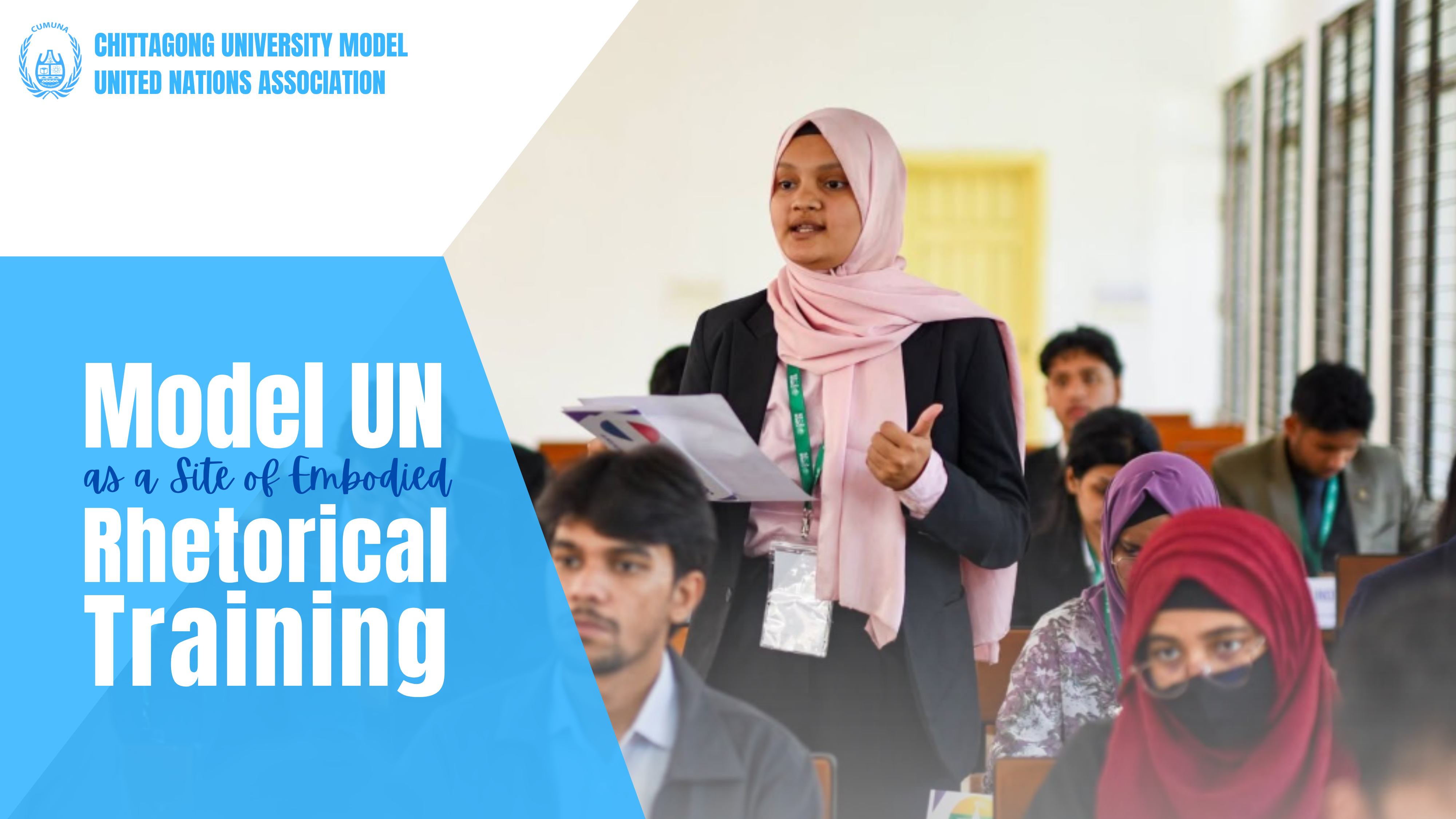
When it comes to public speaking, everyone says, “Build self-confidence.” But can self-confidence really be acquired spontaneously like that? Every MUN alumnus says the experience “built their confidence.” Yet confidence is too vague to teach, too vague to measure, and too vague to explain. Reducing the step-by-step achievements of the MUN structure merely to “confidence” transforms it into a supplementary asset, rather than recognizing it as a genuine, transferable literacy: the ability to construct analytical frames and perform a credible self in a highly coded environment.
As a literature student, I want to frame this differently. Rather than describing MUN as “confidence-building,” we should read it as the cultivation of a specific authorial posture, a paratextual performance of expertise, legitimacy, and diplomatic voice that shapes how delegates are read and heard.
Gérard Genette’s concept of the paratext refers to everything around a text that shapes how it is read before anyone actually reads it: titles, prefaces, covers, and blurbs. In a MUN committee, the position paper, the country placard, the seating order and even formal attire do the same work: they frame a speech before a single word is spoken. A polished position paper buys a mediocre speech more patience than it deserves; a confident placard raise buys a nervous delegate a few extra seconds of the floor’s attention. Delegates learn this by instinct, years before anyone gives them the vocabulary for it. They learn to control the frame before they have even stepped inside it.
Yet framing does not end with documents, titles, or formal symbols; it extends into the delegate's embodied presence, where posture, voice, and demeanor become part of how credibility is established.
Consider posture. In a recent discussion of authorial identity, Ghosh (2023) cites Ruskin Bond to illustrate a character who closely resembles Bond’s grandfather, as described in “From Small Beginnings.” The chapter opens with a quotation from Kim:
“A man may have a hundred disguises, but in the end it is his posture that gives him away.”
Bond recalls that his grandfather, though adept at disguising himself as a fruit vendor or basket maker while roaming the bazaars, was always identifiable by his pronounced slouch. This example shows how an individual’s habitual behaviors and modes of self-presentation function as enduring markers of identity.
The delegate’s voice is a compressed, high-speed version of the same maneuver: a persona assembled specifically to be legible and credible inside a very particular room, switched on at the gavel and switched off the moment the committee ends. It is control, of skill, of practice, of posture, of the gap between what a delegate believes and what they are willing to say on the floor in service of a bloc’s position. That control is a skill. It has a shape. It can be taught, named, and improved, which “confidence” never quite allows for. MUN posture is more like a sketch than a portrait, assembled fast and discarded faster. But the underlying mechanics is a performed self, distinct from private conviction, built to be read a certain way by a particular audience, remain.
Calling all of this “confidence” is not exactly wrong. It is just too small a word for what is actually being built. Confidence is a feeling. What MUN actually teaches is literacy: the ability to construct a frame before you speak and to build a self for a room before that room has heard a word from you.
We can describe the rhetorical situation in five parts: purpose, audience, topic, writer (or speaker), and context. A prototypical rhetorical situation is the standard or ideal model of a communication event, traditionally represented by a face-to-face speech involving a speaker, an audience, and a spoken message. In Model United Nations, the material and procedural setup of the committee room quietly constructs exactly such a prototypical rhetorical situation. The raised dais, the name placards, the ritualized moderated caucuses, and the strict speaking-time limits are not just organizational details; they are the architecture of a specific kind of persuasion. Together, they produce a defined audience (the chair, fellow delegates, and sometimes observers); clear genre expectations (formal speeches, points, motions, and draft resolutions); intense time pressure; and a constant evaluative gaze that judges not only what is said but also how it is said.
Within this environment, students rapidly internalize norms of ethos-construction. “Ethos construction” is a well-established term in rhetoric, literature, and communication; it refers to the deliberate process of building credibility, authority, and trust with an audience to make an argument persuasive. Delegates learn, often without explicit instruction, how to sound like a state rather than an individual: using third-person formulations (“the delegation of…”, “our country believes…”) and depersonalized policy language. They discover how to claim authority without overt self-assertion, adopting a tone that is calm, measured, and ostensibly neutral, even while advancing strategic interests. Procedural phrases such as “the delegate of X yields their time to the chair” or “the delegate moves to close debate” become more than formulae; they function as legitimacy markers that signal familiarity with the house rules and, by extension, competence and belonging. In doing so, they are not simply gaining “confidence”; they are being trained in a situated rhetorical literacy—one that teaches them how to construct and project authority within a highly coded institutional space.
For students from diverse disciplines and backgrounds, MUN functions less as a “diplomacy club” and more as a practical laboratory for real-world communication. It teaches them how to speak with clarity, think with nuance, work with others, and present themselves professionally, skills that matter in classrooms, workplaces, and public life far beyond the committee room. If you are still wondering whether MUN is worth your time, think less about “confidence” and more about concrete, real-life gains you can use. You do not need to dream of becoming a diplomat to benefit; you only need to want to speak, write, think, and present yourself more effectively and have those efforts recognized by others.